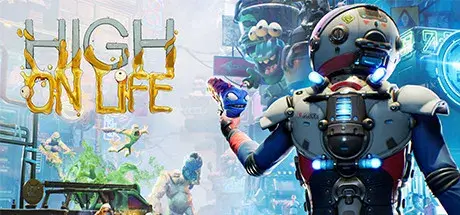
High On Life 2 Review: Talking Guns Return
Squanch Games' sequel brings skateboarding traversal, bigger hub worlds, and the same relentless humor.
Introduction
High On Life was one of 2022's biggest surprises – a comedy FPS where your weapons are sentient aliens that never stop talking, and where the humor ranged from brilliantly absurd to aggressively juvenile. It was rough around the edges, but its personality carried it to Game Pass stardom and built an audience hungry for more. High On Life 2 delivers more, and in some areas – traversal, world design, comedic writing – it delivers better. In others – shooting, technical stability, production values – it takes steps backward.
The sequel follows your bounty hunter protagonist as an alien pharmaceutical conglomerate plans to turn humans into pills. If that premise sounds like something a comedy writer pitched during a brainstorm session that went off the rails, that's essentially what High On Life is: a game that lives or dies on whether its particular brand of chaos amuses you.
Gameplay & Mechanics
The biggest addition is the skateboard. Where the original funneled you through corridors between combat arenas, High On Life 2 builds its three hub worlds around fluid traversal. Rail-grinding, wall-riding, kickflipping off ramps, and chaining momentum through half-pipes transforms movement from a means of getting between fights into a joy in itself. The skateboard doubles as a combat tool – you can grind rails while shooting, launch off ramps for aerial slow-motion shots, and use momentum tricks to access hidden areas. It's the game's central pillar, and it works. Think Tony Hawk meets Metroid Prime, filtered through an Adult Swim sensibility.
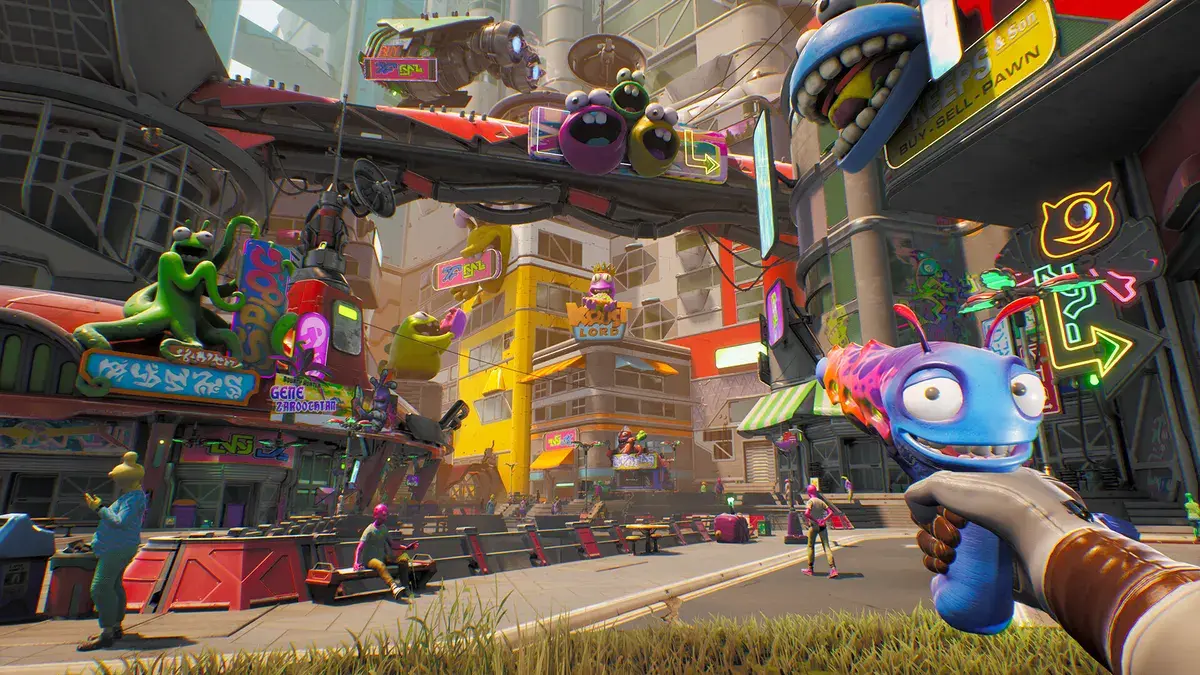
The hub worlds are a significant upgrade over the original's single hub. Each of the three areas – a beachfront resort planet, a neon-drenched cityscape, and a fungal swamp world – is built with Metroidvania-style gating. You'll see unreachable ledges, locked doors, and rail gaps that require abilities you don't have yet. Returning later with new Gatlian (talking gun) abilities opens new paths, secrets, and side bounties. It rewards backtracking in ways the original never attempted.
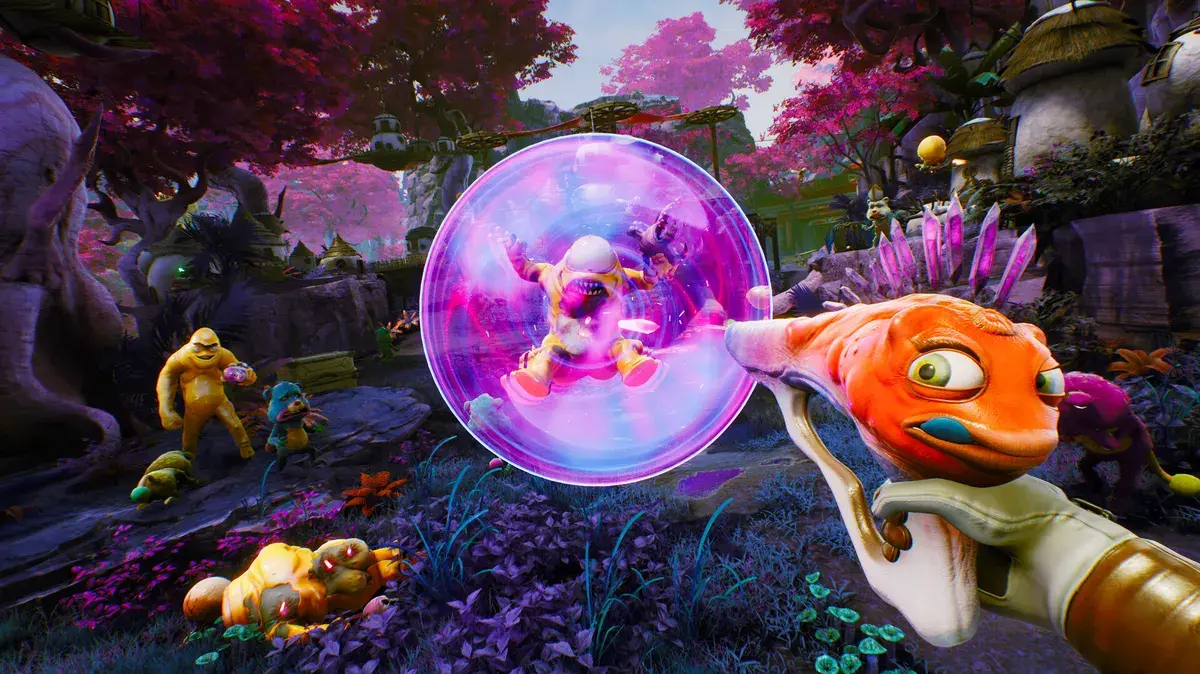
The Gatlians are the franchise's soul, and the new additions are the best yet. Travis and Jan are a married couple – you dual-wield them simultaneously, and they bicker, flirt, and passive-aggressively snipe at each other mid-combat. Travis fires rapid shots while Jan charges a heavy blast, and switching between their fire modes while they argue about whose turn it is to be the primary weapon is comedy gold. The returning guns – Kenny, Gus, Sweezy, and Creature – have new alternate fire modes and upgraded dialogue trees that let you shape their personalities through conversation choices.
Where the game stumbles is the core shooting. Gunplay in High On Life has always been secondary to the comedy, and the sequel doesn't fix the fundamental floatiness. Enemies absorb shots without convincing hit feedback, weapon impact lacks weight, and the auto-aim assists that make the game playable on controller also make it feel imprecise on mouse and keyboard. It's not terrible – it's functional enough to serve the comedy – but it's the weakest element of a game that asks you to shoot things for 15 hours. Compared to DOOM Eternal's razor-sharp gunplay or even Ratchet & Clank's creative weapon design, High On Life 2's shooting is its Achilles' heel.
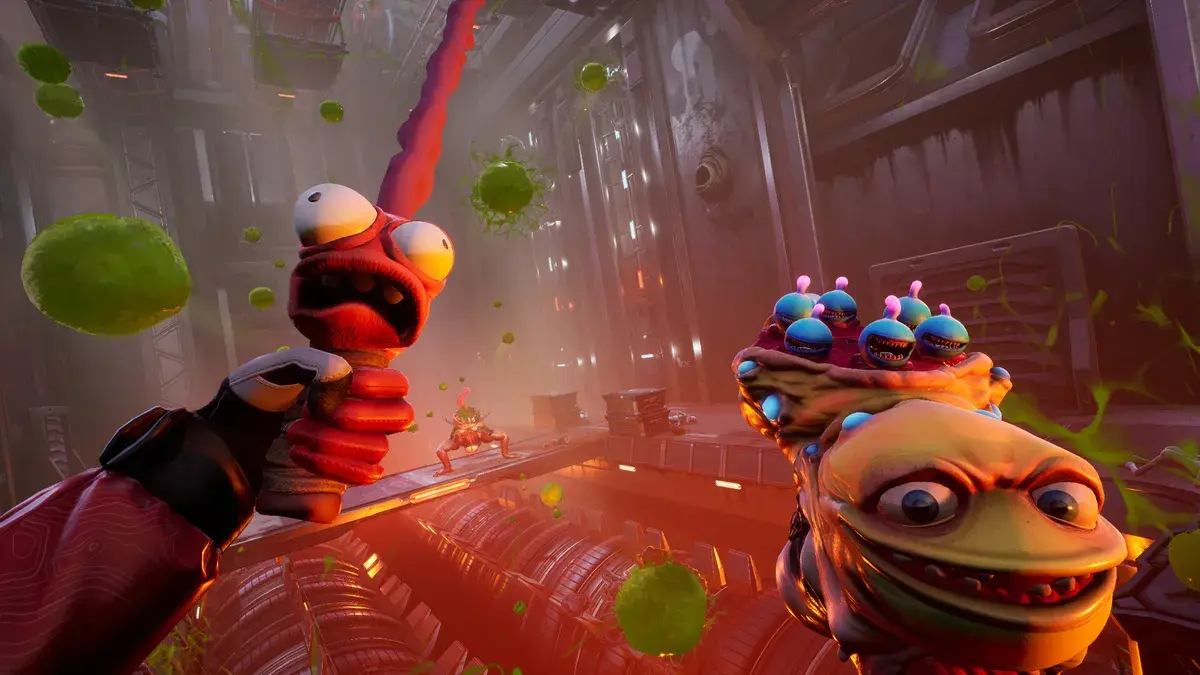
Boss fights are improved. Each bounty target has a gimmick that forces you to use specific Gatlian abilities and skateboard tricks to create openings. A boss fight against a pill-factory foreman involves grinding circular rails to avoid toxic gas while switching between Travis's rapid fire for weak points and Jan's charged shots for shield breaks. It's the kind of encounter design that the first game lacked, and it makes bounty hunting feel like a genuine challenge rather than a shooting gallery.
Graphics & Performance
High On Life 2 runs on Unreal Engine 5, and the visual upgrade from the first game is noticeable but uneven. Hub world environments are colorful and creatively designed, with alien architecture that looks like Lisa Frank designed a drug operation. Character models and animations for major characters are solid. But background textures, NPC density, and environmental detail show clear budget constraints – empty areas feel sparse, and some zones have a "made with fewer resources" quality that's hard to ignore.
Performance is the game's biggest technical problem. At launch on PS5, the game suffers from soft locks where story events fail to trigger, NPCs freeze in place, and combat sequences don't register as completed. I had to reload checkpoints four times during my playthrough due to progression-blocking bugs. Frame drops in crowded combat areas are common, and loading times between hub worlds are longer than expected for current-gen hardware. PC performance is more stable, and the Xbox Series X version reportedly runs best of the three platforms.
Story & Narrative
The story picks up after your bounty hunter has achieved fame and fortune from the first game's events, only to face a new threat: Phalacorp, an alien pharmaceutical conglomerate that's kidnapping humans to process into recreational pills. It's a premise that's simultaneously satirical, gross, and weirdly prescient. The narrative expands across three hub worlds, each controlled by a different Phalacorp executive who serves as a bounty target.
The humor is more consistent than the original's. Where the first game's comedy was scattershot – some jokes landed, many didn't, and the game couldn't stop talking long enough for any single bit to breathe – the sequel exercises more restraint. Jokes have better setup and payoff, characters interrupt each other less, and the quiet moments between comedy beats let the absurdity land harder. Travis and Jan's married-couple dynamic is the comedy highlight, with their bickering adding character depth alongside laughs.
The bounty targets themselves are more developed as characters. Each Phalacorp executive has a pre-fight buildup that includes environmental storytelling, henchman dialogue, and an audio-log trail that humanizes them before the boss fight. One target is a former scientist who believed he was making medicine before the corporation pivoted to human-pill production. Another is a middle manager who's clearly in over his head and begs for mercy mid-fight. These moments of tonal contrast – genuine pathos sandwiched between absurdist humor – are where the writing shows real growth from the first game.
That said, some jokes still miss. A subplot involving a sentient toilet that narrates its own existence goes on about three minutes too long, and a few shock-value gags feel like they belong in a 2012 YouTube sketch rather than a 2026 release. The humor ratio is maybe 70% hit, 30% miss – better than the original's 50/50 split, but still inconsistent.
Audio & Soundtrack
Tobacco's electronic soundtrack is a genuine upgrade, adding atmospheric variety that the first game's music lacked. Hub world themes have distinct identities – the beach resort gets laid-back synthwave, the neon city gets aggressive bass-heavy beats, and the fungal swamp gets eerie ambient textures. Combat music escalates with engagement intensity, and boss themes have memorable hooks. The voice performances are strong across the board, with Travis and Jan's voice actors delivering comedic timing that carries the entire game.
Value & Replayability
The campaign runs about 12-15 hours, with side bounties and secrets pushing a thorough playthrough to 18-20 hours. It's comparable to the first game's length but feels more substantial thanks to the hub world design and Metroidvania backtracking. Dialogue choices affect Gatlian personality development and unlock different conversation paths on subsequent playthroughs, though they don't change story outcomes.
The Switch 2 version launches in April 2026, two months after the initial release, so Nintendo players will benefit from any post-launch patches that address the technical issues. At $40 (compared to the first game's $60 launch), the reduced price point reflects the smaller scope honestly.
Final Verdict
High On Life 2 is a better game than the original in the ways that matter most – the humor is funnier, the worlds are bigger, the traversal is enjoyable, and the boss fights have actual design behind them. But it's also a rougher product, with technical problems that undermine the experience and shooting mechanics that remain the weakest element of a game about shooting things. If you loved the first game's comedy-first approach and can tolerate jank, High On Life 2 delivers enough laughs and creativity to justify the ride. If the original's rough edges already pushed your tolerance, the sequel won't change your mind.
Buy if you enjoyed the first High On Life's humor, you want a comedy FPS with creative traversal, or you're looking for something aggressively different from every other shooter on the market. Skip if you demand polished gunplay from your shooters, technical stability is non-negotiable, or the comedy style from the trailers doesn't resonate with you.
Pros
- Skateboarding traversal is genuinely fun and transforms how you move through levels
- Travis and Jan, the married dual-wield guns, are the funniest Gatlians yet
- Three hub worlds with Metroidvania-style gating offer solid exploration
- The humor is sharper and more restrained than the original's scattershot approach
- Creative enemy designs that lean into the absurdist aesthetic
- Boss encounters are more mechanically interesting than the first game
- Improved soundtrack by Tobacco adds atmospheric variety
Cons
- Technical issues at launch include soft locks, untriggered events, and crashes
- Core shooting mechanics remain sloppy and lack impact
- Made with visibly fewer resources than the original, and it shows in asset quality
- Some humor still misses badly when it reaches for shock over wit
- Performance on PS5 has noticeable frame drops in busy combat sections
Frequently Asked Questions
- Is High On Life 2 on Game Pass?
- No. Unlike the first game, High On Life 2 is not a Game Pass launch title. It's available for purchase at $40 on PC, PS5, and Xbox Series X/S, with a Nintendo Switch 2 version launching in April 2026.
- Do I need to play High On Life 1 first?
- It helps but isn't required. The sequel references events from the first game and returning Gatlian characters have established personalities, but the main story is self-contained. New players will miss some callbacks but won't be lost.
- How long is High On Life 2?
- The main campaign runs 12-15 hours. Side bounties, secrets, and Metroidvania backtracking push a thorough playthrough to 18-20 hours. Dialogue choices offer some replay variety but don't change story outcomes.
- Are the technical issues fixed?
- Squanch Games has released multiple patches since launch addressing soft locks and progression bugs. The game is significantly more stable than at release, though some performance issues remain on PS5. The Xbox Series X version runs best.
Game Info
- Developer
- Squanch Games
- Publisher
- Squanch Games
- Release Date
- 2026-02-13