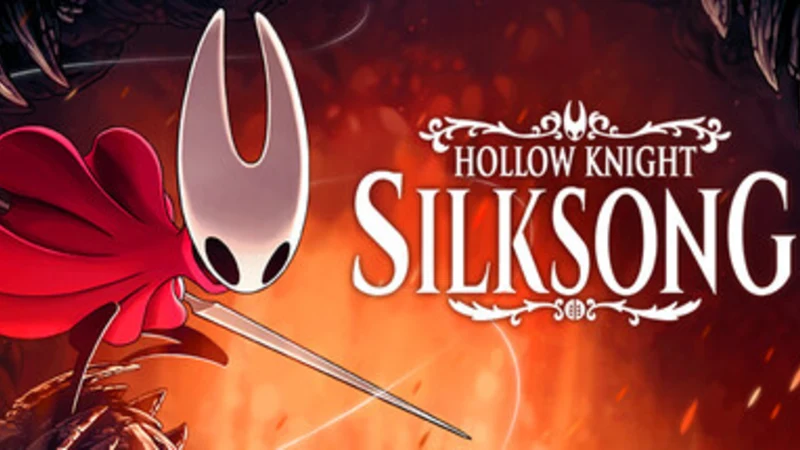
Hollow Knight: Silksong Review: The Wait Was Worth Every Minute
Team Cherry's seven-year follow-up to Hollow Knight is a bigger, harder, more beautiful Metroidvania that refuses to coast on its predecessor. Hornet takes center stage and owns it.
Introduction
Seven years. That is how long we waited between Hollow Knight's 2017 release and Hollow Knight: Silksong's arrival on September 4, 2025. Seven years of delays, missed windows, and the Team Cherry memes reaching mythical status. I booted Silksong up expecting to be disappointed. I closed it 55 hours later and quietly uninstalled every other game on my Switch 2 to make room for a second playthrough. The wait was worth it. The wait was worth every single minute.
Gameplay & Mechanics
Silksong is not a sequel that plays it safe with the original's formula. Hornet controls completely differently from the Knight. Where Hollow Knight was methodical and weighted, Silksong is fast, aerial, and aggressive. Hornet's needle attack is shorter but her basic movement is significantly quicker, her wall-climbing is more generous, and her signature pogo – a downward strike that bounces off enemies and hazards – replaces the nail bounce as the core traversal mechanic. By hour five I was bouncing across entire rooms without touching the ground, chaining three enemies in a single hop, and grinning like an idiot.
The new Silk and Soul system gives you two resource pools to manage. Silk powers healing (binding your wounds with thread) and special skills (Silk Skills), while Soul remains dedicated to combat focus. This dual-resource design creates meaningfully different combat priorities than the original. Do you burn silk on a Silk Skill to delete a boss phase, or save it in case you need to heal? Every fight becomes a resource management puzzle on top of the execution challenge.
Crafting also returns in a much more developed form. Rosary beads (the new currency) fund gear upgrades at Pharloom's many workbenches, and the Tools system – miniature equipment like bombs, throwing needles, and traps that replace the original's Charm system – gives Hornet real loadout flexibility. I built a ranged assassin kit for exploration and a melee duelist kit for boss fights, and swapping between them took seconds.
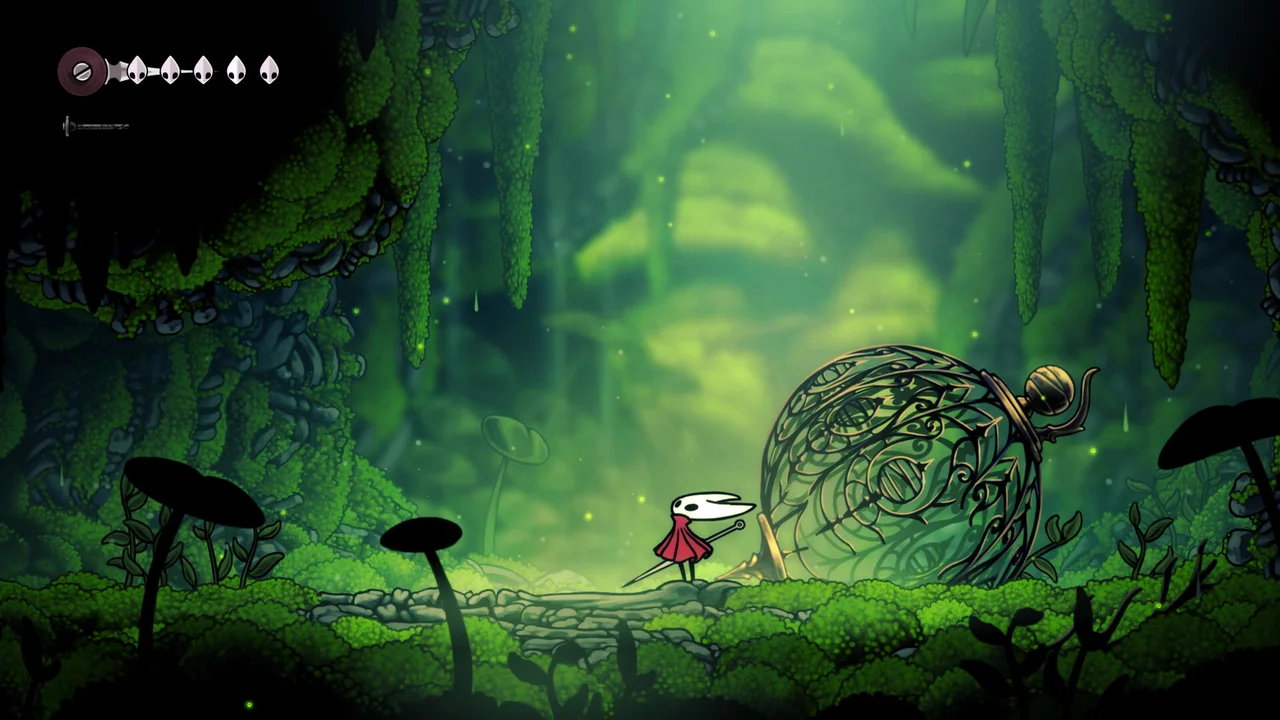
The Metroidvania exploration is bigger, more interconnected, and more vertical than Hollow Knight. Pharloom has three major regions stacked on top of each other, connected by a gorgeous central cathedral city called the Citadel. The map density rewards thorough exploration – I found hidden rooms 40 hours in that changed how I approached bosses I had already beaten.
Graphics & Performance
Team Cherry are the most talented 2D artists currently working in games. Pharloom is drawn by hand, animated by hand, and lit with the kind of painterly touch that makes every screenshot wallpaper-worthy. The pale silk-draped architecture of the Citadel, the bioluminescent fungal forests of the Moss Grotto, the rust-stained mechanical ruins of the Underworks – each region has a visual identity so strong you could pick it out from a single frame.
Performance is rock solid on every platform I tested. Switch 2 holds a locked 60fps in handheld mode. PS5 and Xbox Series X run at 120fps if your display supports it. PC at 4K with high refresh rate is flawless. The game even runs well on the original Switch, which is astonishing given the visual density. Launch had some minor bugs around save file corruption on Switch that Team Cherry patched within a week.
Story & Narrative
This is the area where Silksong is most divisive and where I drop a point from my score. Hornet arrives in Pharloom as a captured stranger dragged there by unknown cultists, and the narrative unfolds through environmental storytelling, item descriptions, and cryptic NPC dialogue – even more opaque than the original Hollow Knight, which is saying something. If you wanted Team Cherry to deliver clearer narrative beats after the original's oblique lore, you will be disappointed.
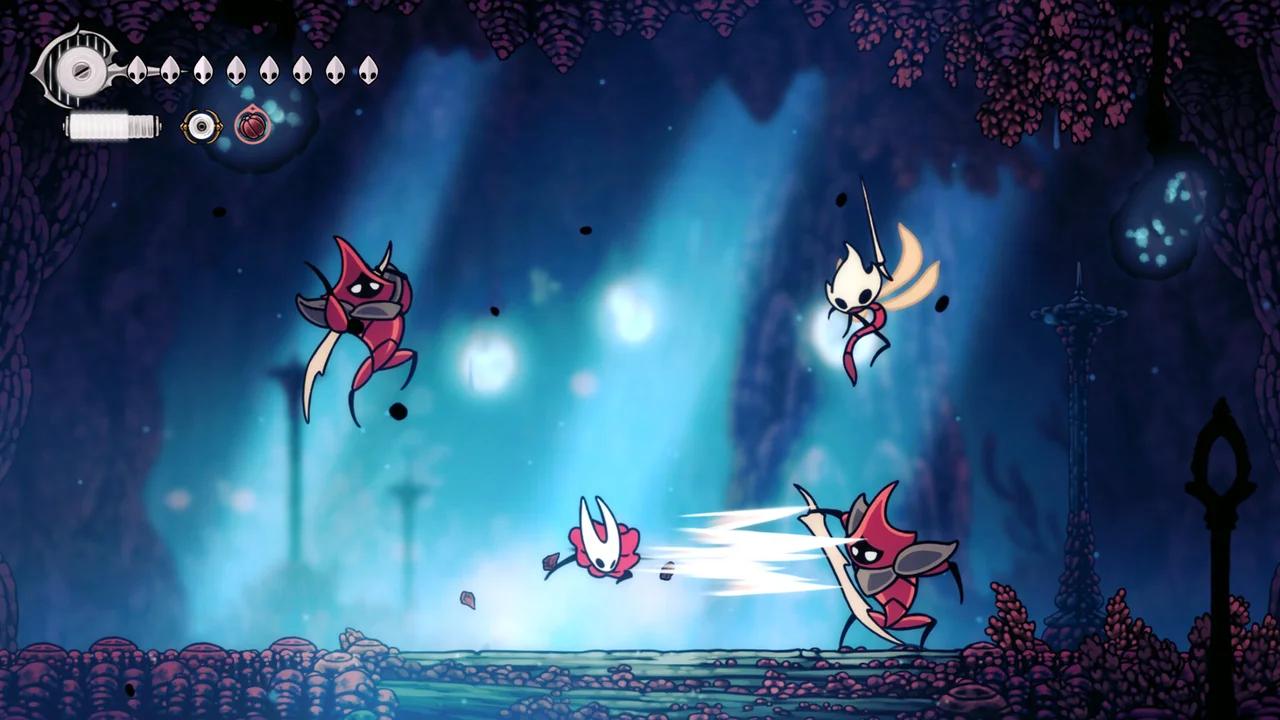
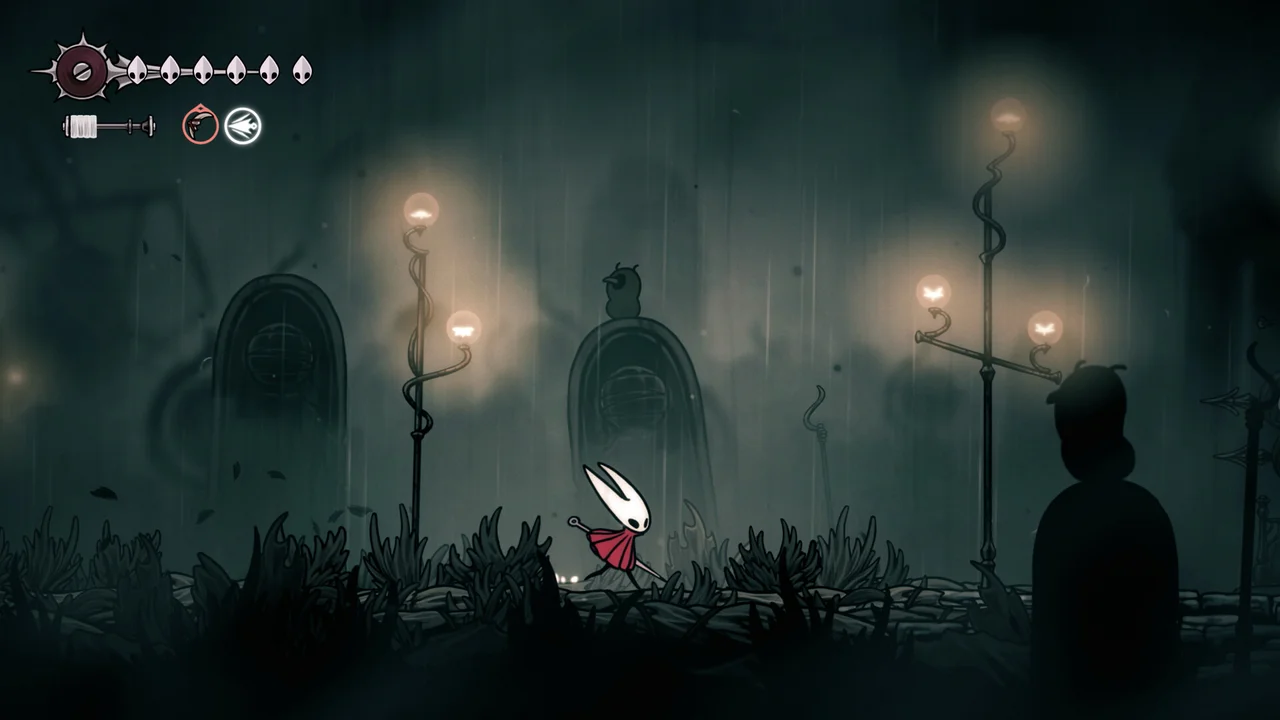
What Silksong offers instead is atmosphere. Pharloom is a dying kingdom clinging to its religion, and the weight of that decay permeates every zone. The Song That Binds, the Silk, the Haunted Chorus – the lore is there, and it is rich, but you have to dig for it. I ended up on the wiki multiple times after my first playthrough to understand what had actually happened. If you enjoy piecing lore together, Silksong is a feast. If you want a cleanly told story, it is frustrating.
Audio & Soundtrack
Christopher Larkin did it again. The original Hollow Knight soundtrack is on most critics' short list of the best game soundtracks of all time, and Silksong's score is every bit its equal. The main theme alone – a haunting string arrangement built around a silk-and-needle motif – is already on my regular listening rotation. Boss themes hit hard without overstaying their welcome. The exploration tracks for Pharloom's major zones create distinct moods that reinforce the art direction without upstaging it.
Sound effects deserve their own paragraph. The thwack of Hornet's needle, the bounce of a successful pogo, the chime of collecting rosary beads – every audio cue is tuned for satisfaction. Playing with good headphones is transformative.
Value & Replayability
At $19.99, Silksong is the best value release of 2025 by a comfortable margin. My first playthrough ran 52 hours. A 100% completion run pushes past 70. The True Ending path demands deep exploration and combat mastery that will eat another 20 hours. For the price of a fast food meal, you get a 50+ hour Metroidvania from one of the best studios in the medium.
Post-launch support is also live. Team Cherry announced Sea of Sorrow, a free DLC releasing in 2026 that adds new areas, bosses, tools, and story content focused on Hornet's voyage beneath the salt-stricken seas. Free. DLC. For a $20 game that was already massive. If there is a better content-per-dollar ratio in gaming, I have not seen it.
Final Verdict
Hollow Knight: Silksong does exactly what a sequel should do: it takes everything the original did well and builds a bigger, more confident, more ambitious version around a new protagonist with a distinct identity. The combat is faster and more technical. The world is bigger and more beautiful. The soundtrack is incredible. The boss design is the best in the genre. And Team Cherry somehow shipped it for $20 with free DLC on the way.
The narrative opacity and harsher difficulty keep it from matching the original's perfect balance for newcomers, which is why I land at 9/10 instead of 10. But if you played and loved Hollow Knight, Silksong is not optional. It is the release of the year for anyone who loves 2D platformers, Metroidvanias, or tight action design.
Buy if: You loved Hollow Knight, you enjoy Metroidvanias, or you want to see the ceiling of what a small team can do with 2D art. Essential at $19.99.
Skip if: You bounced off Hollow Knight's difficulty or its cryptic storytelling. Silksong is harder and more opaque on both counts.
Pros
- Hornet's fast, aerial moveset makes traversal feel fundamentally different from Hollow Knight
- Pharloom is larger than Hallownest with more distinct biomes and vertical exploration
- Boss roster is the best in the Metroidvania genre - every fight is a puzzle worth memorizing
- Christopher Larkin's soundtrack is every bit the equal of the original's iconic score
- 92 Metacritic and Universal Acclaim confirm the seven-year wait delivered
- $19.99 price point is borderline criminal for the amount of content on offer
- Free Sea of Sorrow DLC coming in 2026 extends the value even further
Cons
- Notably harder than Hollow Knight - boss runbacks will frustrate newcomers
- Narrative is even more opaque than the original; expect to read wikis to understand lore
- Early-game crafting economy can leave you cash-starved if you explore inefficiently
- Some diagonal-pogo challenge rooms demand frame-perfect precision few players will enjoy
Frequently Asked Questions
- Is Hollow Knight: Silksong harder than Hollow Knight?
- Yes, noticeably. Bosses hit harder, runbacks are longer, and enemy damage scales more aggressively. Diagonal-pogo platforming challenges in particular demand more precision than anything in the original Hollow Knight. Veterans of the first game should expect a step up in difficulty.
- How long is Hollow Knight: Silksong?
- A standard playthrough runs 45-55 hours. 100% completion and True Ending paths push the total to 70-80 hours. The world of Pharloom is larger than Hallownest with more distinct regions and a denser interconnected map.
- Do you need to play Hollow Knight before Silksong?
- No, Silksong is playable as a standalone entry point. However, players who finished Hollow Knight will catch references and appreciate Hornet's expanded characterization. The story does not require prior knowledge to follow.
- What platforms is Hollow Knight: Silksong on?
- Silksong released September 4, 2025 on PC (Steam, GOG), PlayStation 4, PlayStation 5, Xbox One, Xbox Series X|S, Nintendo Switch, and Nintendo Switch 2. It is available on Xbox Game Pass and PlayStation Plus Extra.
- Is the Sea of Sorrow DLC free?
- Yes. Team Cherry announced Sea of Sorrow as free DLC scheduled for 2026, adding new areas, bosses, tools, and story content centered on Hornet's voyage beneath the seas. It follows Team Cherry's tradition of releasing free content updates post-launch.
Game Info
- Developer
- Team Cherry
- Publisher
- Team Cherry
- Release Date
- 2025-09-04
- Platforms
- PC, Switch 2, Xbox Series X|S, PS5, Nintendo Switch
- Genres
- Action, Platformer