Almost Out of Mana Review: Big Brain Puzzles
Solo developer Tepes Ovidiu delivers a premium mobile puzzle game where every spell counts. Almost Out of Mana is small, clever, and refreshingly respectful of your time and wallet.
Introduction
Almost Out of Mana does exactly what its title promises. You're a wizard. You're almost out of mana. Every spell you cast has to count, because there won't be enough magical energy to fix a mistake. That's the entire premise of this $2.99 mobile puzzle game from solo developer Tepes Ovidiu, and it's stretched into one of the tightest, most focused puzzle experiences I've played on my phone this year. In a mobile landscape drowning in free-to-play padding and aggressive monetization, Almost Out of Mana is a refreshing breath of premium air. It won't take over your life, but the few hours it occupies will challenge your brain in ways that feel satisfying.
Gameplay & Mechanics
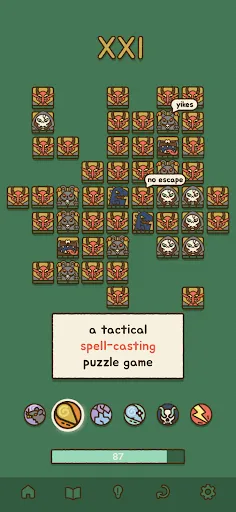
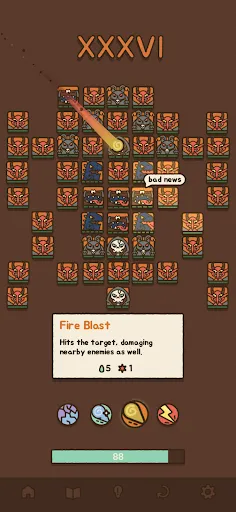
Each level presents a grid populated by enemies with visible health values and a mana bar at the bottom of your screen displaying an uncomfortably small number. Your job is to eliminate every enemy using your spell arsenal before your mana hits zero. Spells vary by mana cost, damage output, and area of effect, some hit a single target hard, others splash damage across multiple enemies, and a few apply status effects or interact with the environment.
The turn-based structure is key to what makes this work. There are no timers. You can sit and stare at the board for as long as you need, calculating exactly how a specific spell sequence will play out. Which enemies should you prioritize? Is it more mana-efficient to use two cheap spells on a cluster or one expensive spell that covers the whole group? Should you save your most powerful spell for the toughest enemy or use it early to thin the herd? These decisions form the puzzle's core, and the game is remarkably good at creating configurations that have one or two optimal solutions buried among many tempting but ultimately fatal approaches.
As you progress, enemy variety increases. Some enemies have armor that reduces damage. Others heal adjacent allies. A few have special resistances that force you to use specific spell elements. The mana economy tightens as well; stronger enemies appear alongside your growing collection of more powerful but more expensive spells, ensuring that the fundamental tension of "not enough mana" persists throughout. It's a well-designed difficulty curve that occasionally spikes when new mechanics are introduced, but generally respects the learning pace.
The pacing deserves credit. New mechanics are introduced gradually, never overwhelming you with too many variables at once. A level might introduce armored enemies that require a specific element to crack, then the next level combines those armored enemies with healers in a configuration that demands you solve the armor problem first or waste mana on damage that gets undone. It's the kind of layered puzzle design that Into the Breach does at a grander scale, and while Almost Out of Mana doesn't reach those heights, it operates from the same design philosophy of making every resource allocation meaningful.
Where Almost Out of Mana falters is in its ceiling. Experienced puzzle gamers will blow through the content in a few hours. The puzzles are well-designed but finite, and once you've figured out the optimal solution for each level, there's little reason to return. There's no random generation, no scoring system, and no alternative challenge modes to extend the experience. A new game plus mode with shuffled enemy configurations or a daily challenge system would have extended the lifespan considerably. As it stands, it's a game that burns bright and then simply ends.
Graphics & Performance
The visual presentation is clean and functional. A 2D grid layout with clearly differentiated enemy sprites, readable health values, and an ever-present mana bar that communicates the game's central constraint at a glance. It's not going to win any art direction awards, but everything you need to make informed decisions is immediately visible.
The fantasy aesthetic is generic but inoffensive: standard wizard-and-monsters fare with colorful spell effects that provide satisfying visual feedback when you clear a cluster of enemies with a well-placed area spell. Enemy designs are varied enough to distinguish types at a glance, which is critical when you need to identify priorities quickly.
Performance is flawless. As a 2D puzzle game with modest visual ambitions, it runs perfectly on any device capable of opening the App Store. Load times are instant. The UI is responsive. There's nothing to complain about technically, which for a $2.99 indie game is exactly the standard you'd hope for.
Story & Narrative
There's no story to speak of. You're a wizard fighting enemies with limited mana. The game doesn't try to justify this setup with lore or worldbuilding, and it doesn't need to. The fantasy framing exists to give the puzzle mechanics a visual language, spells, enemies, mana, that players instantly understand. Some puzzle games benefit from narrative wrapping; Into the Breach uses its time-loop framing to enhance the gameplay loop. Almost Out of Mana is more in the Baba Is You camp of letting pure puzzle design speak for itself.
It's not a criticism. Not every game needs a story. Baba Is You gets by purely on its puzzles, and Almost Out of Mana operates in similar territory. But for players who use narrative as motivation to push through challenging content, the absence might make it harder to stay engaged during the tougher levels. Even a thin framing device, a wizard's tower to ascend, a dungeon to escape, would have given players a sense of progression beyond watching a level number tick upward.
Audio & Soundtrack
The audio accompaniment is modest. A low-key fantasy soundtrack plays in the background, pleasant enough to listen to but unlikely to lodge in your memory. Spell sound effects provide appropriate feedback, the crackle of a fire spell, the whoosh of a wind blast, the satisfying shatter of an enemy's last health point. Nothing remarkable, nothing offensive. Like the visuals, the audio does its job and stays out of the way.
For a game you'll likely play in short bursts on a phone, the audio design is appropriately restrained. It enhances the atmosphere without demanding attention, and playing on mute doesn't meaningfully diminish the experience.
Value & Replayability
At $2.99, Almost Out of Mana is priced fairly for what it offers. That's less than a coffee, and you'll get somewhere between three to six hours of focused, uninterrupted puzzle-solving depending on your skill level, with no ads, no microtransactions, and no pop-ups begging you to rate the app. In the context of mobile gaming, where free-to-play games routinely waste more of your time on unskippable ads than you'd spend playing Almost Out of Mana, the premium model is a trade-off that respects your experience.
The replayability concern is real, though. Once solved, levels don't offer much reason to return. There are no star ratings, no par times, no leaderboards, and no community-created level editor. You solve the puzzle and move on. For some players that's fine, especially on mobile where you might never revisit a completed game anyway. For others who measure value in hours per dollar, the one-and-done nature reduces the value proposition. Compared to something like Baba Is You, which offers hundreds of puzzles with mind-bending complexity, Almost Out of Mana is a smaller, tighter experience that knows its scope and delivers within it. The developer's choice to keep the game compact rather than padding it with filler levels deserves respect, even if it means the experience is fleeting. In mobile gaming especially, there's something to be said for a game that ends before it overstays its welcome rather than stretching thin content across weeks of daily login rewards and energy timers.
What it does, it does well. The question is simply whether that's enough for you.
Final Verdict
Almost Out of Mana is a reminder that small games can be great games. Solo developer Tepes Ovidiu has crafted a focused puzzle experience where the central constraint of limited mana transforms every level into a satisfying brain teaser. The turn-based design, spell variety, and escalating enemy complexity create a difficulty curve that consistently engages without overwhelming. It's short, it's simple, and it's one of the best three dollars you'll spend on mobile this year. Think of it as the puzzle equivalent of a well-crafted espresso: small, concentrated, and exactly what you need.
Buy if: You enjoy thoughtful puzzle games like Into the Breach or Baba Is You and want a premium mobile experience that respects your time.
Skip if: You need dozens of hours of content, prefer action-oriented gameplay, or want narrative motivation to push through challenges.
Pros
- Core mana management mechanic creates genuine tension in every single level
- Turn-based design lets you analyze and plan without time pressure
- Premium pricing with no ads or interruptions respects your experience
- Spell variety encourages creative solutions to enemy configurations
- Perfectly sized for short mobile play sessions during commutes
- Clean UI that communicates enemy health and mana costs at a glance
- Solo developer passion project with polished execution
Cons
- Content runs short for experienced puzzle players who solve levels quickly
- Visual presentation is functional but forgettable
- No meaningful narrative to contextualize the puzzle-solving
- Difficulty spikes can feel arbitrary when new enemy types are introduced
- Limited replay value once you've solved all puzzles optimally
Frequently Asked Questions
- How long is Almost Out of Mana?
- Most players will complete all puzzles in three to six hours depending on puzzle-solving experience. It's a compact game designed for short sessions. There are no random elements or alternative modes to extend the playtime beyond the authored puzzle set.
- Is Almost Out of Mana a free-to-play game?
- No. It's a premium purchase priced at $2.99 on both iOS and Android. There are no ads, no microtransactions, and no interruptions. You pay once and get the complete experience, which is a rarity in mobile puzzle games.
- What type of game is Almost Out of Mana?
- It's a turn-based tactical puzzle game where you cast spells with limited mana to defeat enemy configurations. Think of it as a cross between a chess puzzle and a fantasy resource management game. No time pressure, just careful planning and spell optimization.
- Is Almost Out of Mana difficult?
- The difficulty scales well from accessible early puzzles to genuinely challenging late-game levels. The turn-based design means you're never rushed, so difficulty comes from figuring out optimal spell sequences rather than execution speed. Experienced puzzle gamers will find it manageable; newcomers will face a fair challenge.
Game Info
- Developer
- Crevasse
- Publisher
- Crevasse
- Release Date
- 2026-01-01
- Platforms
- Mobile
- Genres
- RPG, Action, Adventure