Lords of the Fallen Review: Dual-Realm Soulslike
Hexworks' ambitious Soulslike introduces a brilliant dual-realm mechanic that makes exploration genuinely thrilling, but excessive enemy density and pacing problems in the back half drag.
Introduction
The Soulslike genre has a crowding problem. After Elden Ring redefined what a From Software-inspired game is, every studio with a dark fantasy pitch deck started lining up for their shot. Lords of the Fallen, a 2023 reboot of the forgettable 2014 original, enters this crowded field with one brilliant idea: the Umbral lamp. Peer into the dead realm overlaid atop the living world, solve puzzles across two planes of existence, and get a second chance at life when you die. It's a hook strong enough to carry a game.
For about 25 hours, it does. Then the second half happens, and what began as a remarkable soft reboot unravels into enemy-spam frustration and recycled encounters. Lords of the Fallen is a textbook tale of two halves.
Gameplay & Mechanics
The core loop will be familiar to anyone who has touched a Soulslike: explore interconnected levels, fight enemies to collect Vigor (this game's souls equivalent), rest at Vestiges (bonfires), level up, push forward. Combat uses a stamina system with light attacks, heavy attacks, blocking, and dodging. There's nothing revolutionary about the action itself, but it feels weighty and responsive in the way a good Soulslike should.
What makes Lords of the Fallen special is the Umbral lamp. At any point during exploration, you can hold up the lamp to peer into the Umbral realm – a grotesque mirror version of the Axiom (living) world layered on top of the same geometry. Platforms that don't exist in Axiom appear in Umbral. Walls that block your path dissolve into bone scaffolding. Paths through seemingly dead-end rooms open up when you shift your perspective. It's a genuine puzzle mechanic layered on top of a Soulslike, and it works brilliantly.
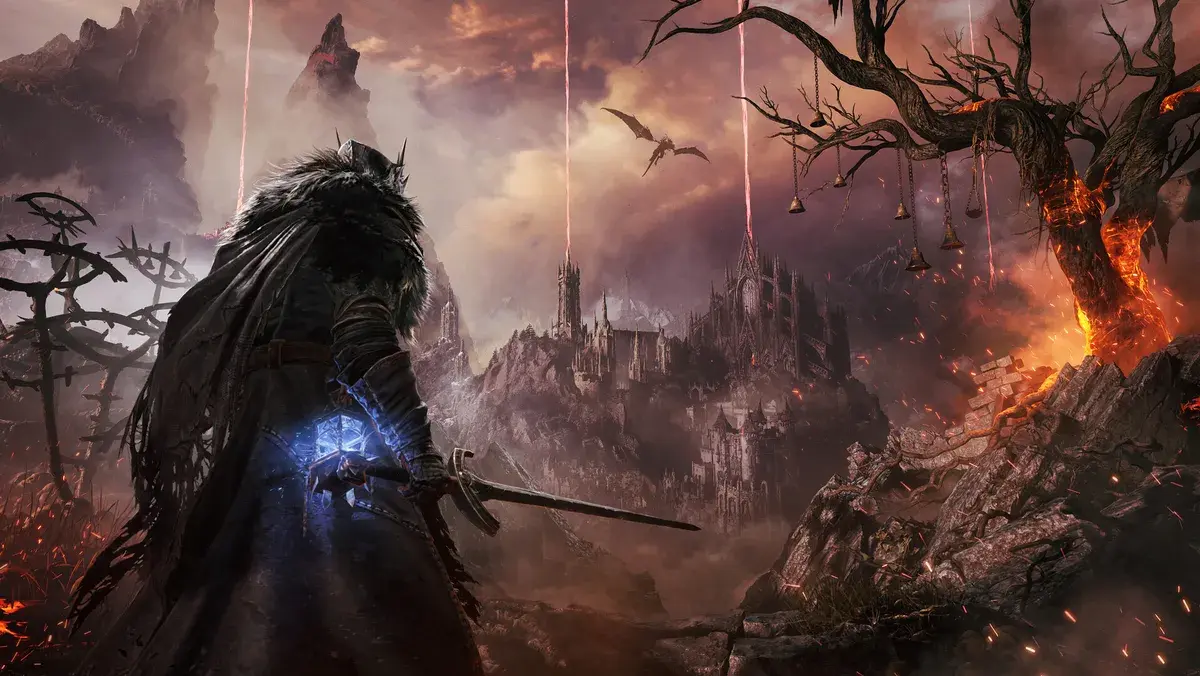
The lamp also functions as a death mechanic. When you die in Axiom, instead of respawning at a checkpoint, you're dumped into Umbral with a sliver of health and a chance to fight your way to an emergence point. It reduces the sting of death without eliminating consequence – spend too long in Umbral and increasingly dangerous enemies spawn to hunt you down. It's the most elegant death mechanic in the genre since Sekiro's resurrection system.
Where things fall apart is enemy placement. Hexworks islieve that Soulslike difficulty means packing every hallway with as many enemies as the engine can render. The first half distributes foes thoughtfully – a knight guarding a bridge, an ambush around a corner, a mini-boss blocking a shortcut. By the Fief of the Chill Curse and beyond, rooms are flooded with overlapping enemies, ranged attackers stacked on elevated platforms, and minibosses recycled as regular mobs. It's not difficult in a satisfying way; it's exhausting. Elden Ring handled mob density with purpose and restraint. Lords of the Fallen handles it with a copy-paste tool.
Boss design follows the same trajectory. Early bosses like Pieta, She of Blessed Renewal are tense, well-telegraphed fights with readable attack patterns and satisfying windows for punishment. Late-game bosses like the Lightreaper feel arbitrarily punishing, with AOE spam and tracking attacks that punish defensive play without offering clean counterplay options. Two bosses in particular felt so poorly tuned that I summoned a co-op partner just to get past them, not because they were hard, but because fighting them solo was unenjoyable.
Character building offers nine starting classes with distinct stat distributions, from the agile Exiled Stalker to the faith-scaling Orian Preacher. The class system provides a solid foundation, but build diversity narrows as you level. Strength and Radiance builds dominate the meta because the game's most reliable weapons scale with those stats, while Agility builds struggle in the late game when enemy density makes dodging through crowds nearly impossible. Inferno (dark magic) builds are fun for their spectacle but lack the damage output to compete on higher difficulties.
Exploration is where Lords of the Fallen earns its keep. Shortcut discovery follows the Soulslike playbook – kick down ladders, open doors from the other side, find elevators back to Vestiges – but the dual-realm twist means every area effectively has two versions worth exploring. A dead end in Axiom might hide a critical path in Umbral. A seemingly decorative wall in the living world might dissolve into a bone archway that leads to an entirely hidden boss. The first half's level design is excellent, with interconnected areas that loop back on each other in satisfying ways that rival the best of Dark Souls' Lordran.
Vestiges (the game's bonfire equivalent) use an interesting twist: in addition to fixed Vestiges, you can plant temporary Vestiges using consumable seeds. This creates a risk-reward calculation – burn a rare seed to create a checkpoint before a tough area, or save it for later and risk losing progress. It's a clever system that gives players agency over their safety net, and it partially mitigates the frustration of the late game's punishing sections by letting prepared players create their own fallback points.
Graphics & Performance
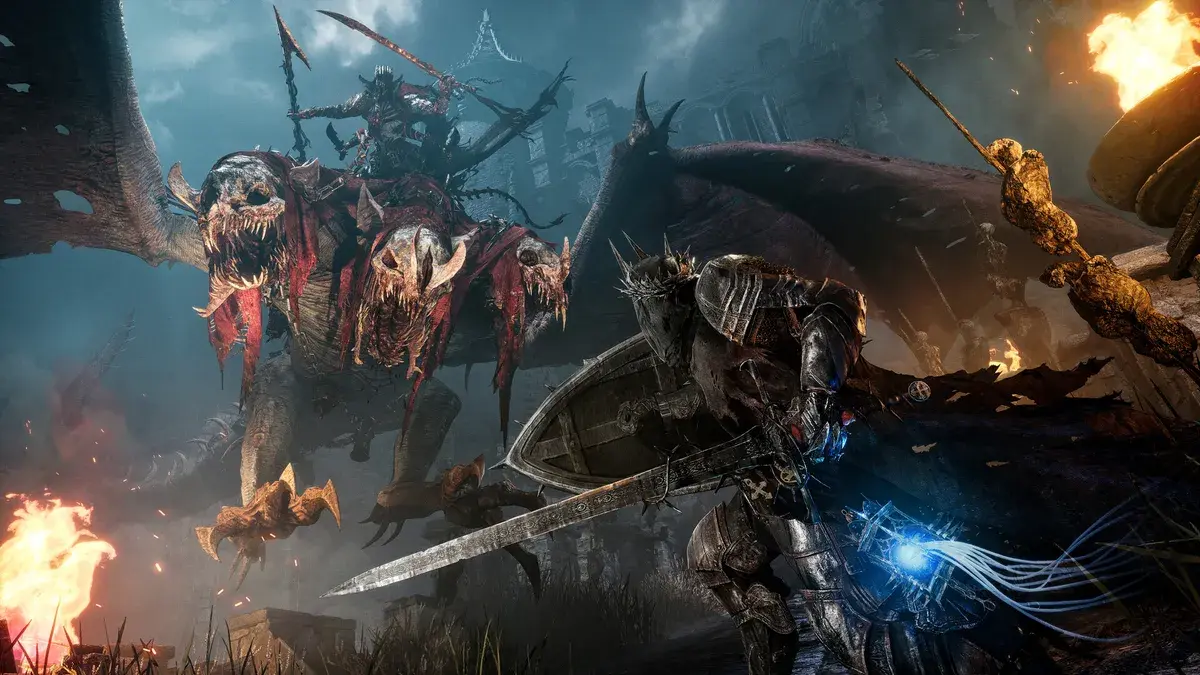
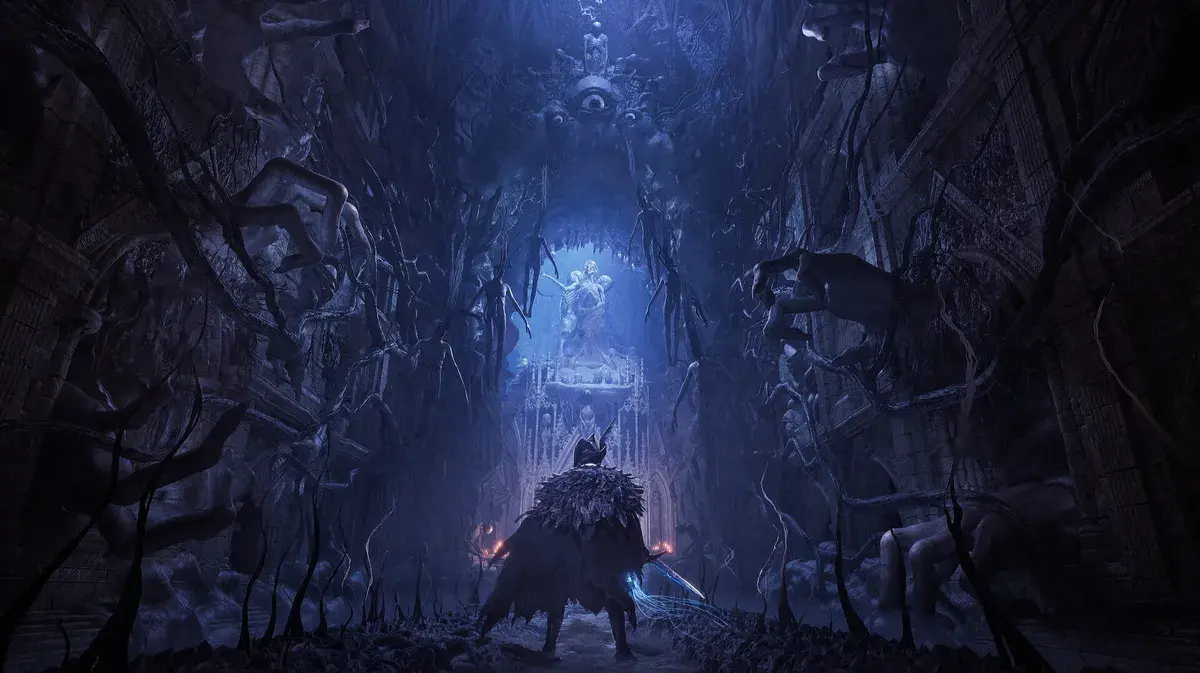
Built on Unreal Engine 5, Lords of the Fallen is a visually striking game. The Axiom world features crumbling cathedrals, mist-choked swamps, and towering fortresses rendered with impressive material detail. The Umbral realm is even more impressive – organic, fleshy architecture writhes and pulses with a biological horror aesthetic that channels HR Giger without directly copying it. Switching between realms mid-stride and watching the world warp around you never stops being cool.
Performance, however, was rough at launch on PS5. Frame drops during crowded Umbral sections could dip into the low 20s, and traversal stuttering when loading new zones was common. Post-launch patches have improved things considerably – as of the latest update, the game mostly holds 30fps in quality mode and 60fps in performance mode, though dense Umbral areas still cause hitching. PC performance scales better with hardware, and a mid-range rig can maintain 60fps at 1440p without much trouble.
Story & Narrative
The story is standard dark fantasy fare: the god Adyr was imprisoned by the forces of Orius, the world is decaying, and you're a Dark Crusader tasked with cleansing corrupted beacons across the land. It's functional rather than compelling, delivered through item descriptions, NPC dialogue, and environmental storytelling that borrows liberally from Dark Souls' playbook without matching its subtlety.
Multiple endings tied to NPC quest lines add some replay incentive, and the lore behind the Axiom/Umbral split is interesting when you dig into it. But most players will experience the story as atmospheric wallpaper rather than a driving motivation, which is fine for the genre but represents a missed opportunity given how unique the dual-realm concept is.
Audio & Soundtrack
The soundtrack is a genuine highlight. Composer Cris Velasco delivers an orchestral score that shifts from haunting choral arrangements in Umbral to thundering brass during boss encounters. The Umbral realm's ambient sound design is particularly effective – wet, organic sounds layer with distant screams to create persistent unease. Voice acting from major NPCs is surprisingly strong, with the Stomund character being a standout performance.
Value & Replayability
A first playthrough runs roughly 40-50 hours depending on exploration thoroughness and death frequency. Multiple endings, nine character classes, and the seamless co-op system provide solid replay value. New Game Plus remixes enemy placements and adds higher-tier loot, though whether you'll want to subject yourself to the late-game enemy gauntlets a second time is another question.
The co-op deserves special praise. Unlike Elden Ring's convoluted summoning system, Lords of the Fallen lets you invite a friend and play through the entire game seamlessly with shared progression. It's the single best quality-of-life feature in the game, and it transforms otherwise frustrating encounters into great fun cooperative challenges.
Post-launch support has been commendable. Hexworks released multiple major patches addressing performance, enemy balance, and even redesigning some late-game areas based on community feedback. A new arena mode offers wave-based combat challenges, and seasonal content updates have added new weapons, armor sets, and a free story expansion exploring the Umbral realm's origins. These updates don't fix the fundamental pacing problems, but they demonstrate a studio that listens to criticism and actively improves its product. It's the kind of ongoing commitment that's become rare in the single-player Soulslike space.
Final Verdict
Lords of the Fallen is a game at war with itself. Its best ideas – the Umbral lamp, the dual-realm exploration, the seamless co-op – are fresh additions to the Soulslike formula. Its worst instincts – enemy spam, recycled minibosses, artificial difficulty through volume rather than design – undermine those ideas in the second half. It's a 9/10 game for its first 25 hours and a 5/10 game for its last 20.
Buy if you're a Soulslike fan hungry for something with a unique hook, you plan to play co-op with a friend, or you can forgive a rocky second half for a brilliant first one. Skip if you have low tolerance for artificial difficulty spikes, performance issues frustrate you, or you're looking for a Soulslike that maintains consistent quality from start to finish.
Pros
- The Axiom/Umbral dual-realm system is a fresh and clever addition that makes exploration thrilling
- Gothic art direction and world design are dripping with dark atmosphere
- Seamless co-op throughout the entire game is a huge quality-of-life win
- Combat fundamentals feel weighty and satisfying in isolated encounters
- Umbral lamp mechanic adds a second-chance death system that reduces frustration
- Excellent voice acting and atmospheric sound design
- Unreal Engine 5 delivers impressive visual fidelity in both realms
Cons
- Enemy density becomes oppressive in the second half, mistaking quantity for challenge
- Several late-game bosses are unenjoyable rather than difficult
- Performance issues on PS5 at launch, with frame drops in crowded areas
- Level design quality degrades significantly after the midpoint
- Lock-on camera fights you almost as hard as the enemies do
Frequently Asked Questions
- How long is Lords of the Fallen?
- A first playthrough takes roughly 40-50 hours depending on exploration and death frequency. The game has multiple endings and New Game Plus, so completionists can expect 80+ hours across multiple runs.
- Can you play Lords of the Fallen co-op?
- Yes, and it's one of the game's best features. Seamless co-op lets you invite a friend to play through the entire campaign together with shared progression. Unlike Elden Ring, there's no convoluted summoning system – just invite and play.
- How does the Umbral realm work in Lords of the Fallen?
- The Umbral lamp lets you peer into a parallel dead realm overlaid on the living world. Platforms, paths, and secrets hidden in one realm become visible in the other. When you die in the Axiom (living) realm, you get a second chance in Umbral before truly dying.
- Is Lords of the Fallen harder than Elden Ring?
- It's differently difficult. Early-game difficulty is comparable to Elden Ring, but the late game ramps up enemy density to frustrating levels. The game is hard, but much of the difficulty comes from sheer enemy volume rather than carefully designed challenge.
Game Info
- Developer
- Hexworks
- Publisher
- CI Games
- Release Date
- 2023-10-13
- Platforms
- PC, Xbox Series X|S, PS5
- Genres
- RPG, Action