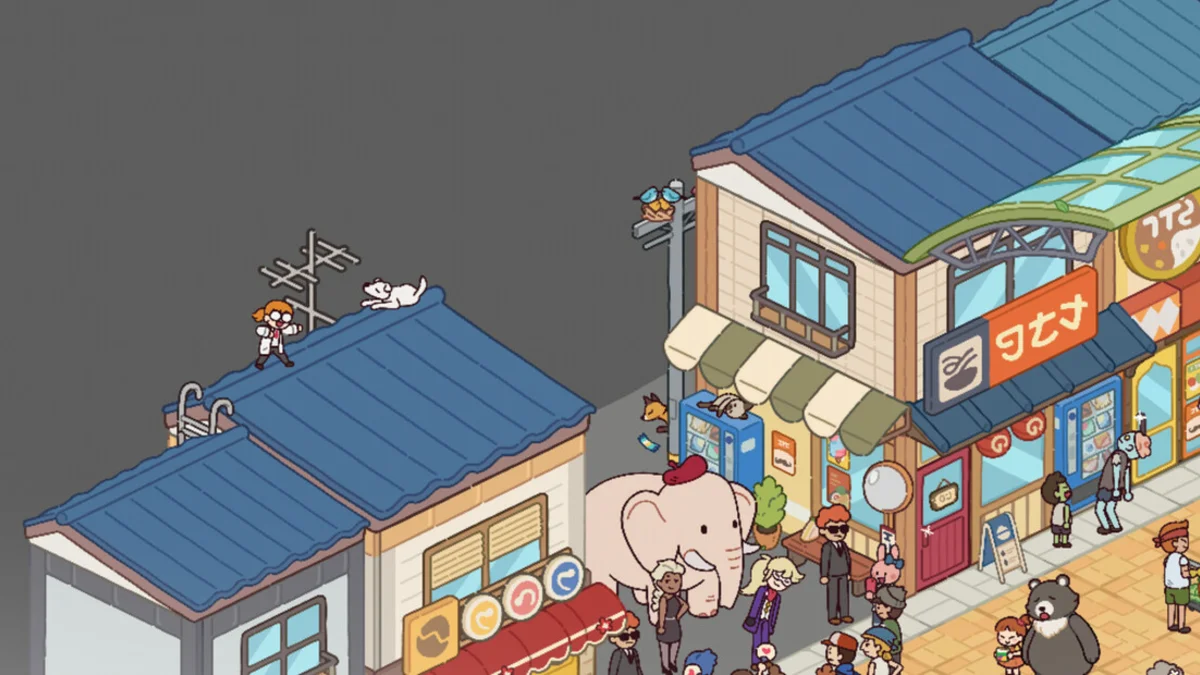
Lost and Found Co. Review: The Most Delightful Game of 2026
Lost and Found Co. is a hidden object puzzle adventure of extraordinary warmth, with animations so alive they made me forget I was staring at pixels. Ducky deserves a spot in gaming's hall of charming protagonists.
Introduction
Lost and Found Co. is the highest-rated game of 2026 so far. Metacritic 90. OpenCritic 90. These numbers are not a fluke — they reflect something genuine about what Bit Egg Inc. has built here. But scores cannot fully communicate what makes this game feel special, so let me try a different angle: there is a scene about forty minutes into Lost and Found Co. where a tiny cat in the background of a market scene is attempting, with great seriousness and apparent futility, to catch a floating soap bubble. Nobody pointed this out to me. It was just there. I only noticed because I was staring at the scene looking for a hidden object and my eye drifted. I sat there for a full minute watching it.
That cat has nothing to do with the main quest. It was animated by someone at Bit Egg Inc. who cared enough to put it there. That care is everywhere in this game.
Lost and Found Co. puts you in the webbed feet of Ducky — a duck who has been transformed into a human, which causes significant distress — and sets you to work as an intern at a magical startup run by the warm and slightly terrifying Goddess Mei. The company's business: finding lost things for the residents of a fantastical town full of people who have misplaced exactly the wrong things at exactly the wrong times. It is charming from minute one and somehow sustains that charm across every hour of play. Thailand's largest indie studio has made something extraordinary here.
Gameplay & Mechanics
The genre is hidden object puzzle adventure, and Lost and Found Co. executes that formula at a level that puts pressure on its peers to improve. Each chapter sends you into a richly detailed environment to locate specific items for specific clients, with puzzle layers woven through the search to prevent the experience from becoming pure pointing and clicking.
What separates this from lesser hidden object games is the interaction density. Objects can be combined, repositioned, activated. A lost key might be visible in a scene but unreachable until you figure out that the wind chime above it needs to be stilled, which requires finding a piece of cloth, which is tucked behind a character who will only move if you complete a separate small task for them. The logic is always fair. I never found myself stuck in a way that felt arbitrary. The puzzle design trusts you.
Ducky's duck instincts occasionally override their human behavior — they will quack involuntarily in formal situations, attempt to eat things that should not be eaten, and fixate on bodies of water with an intensity that derails conversations at crucial moments. These are not just comedic touches. The duck instinct system is mechanically woven in: certain hidden objects can only be located by acting on a duck instinct, which requires recognizing the prompts and leaning into them rather than fighting them. It is a small system but elegantly designed.
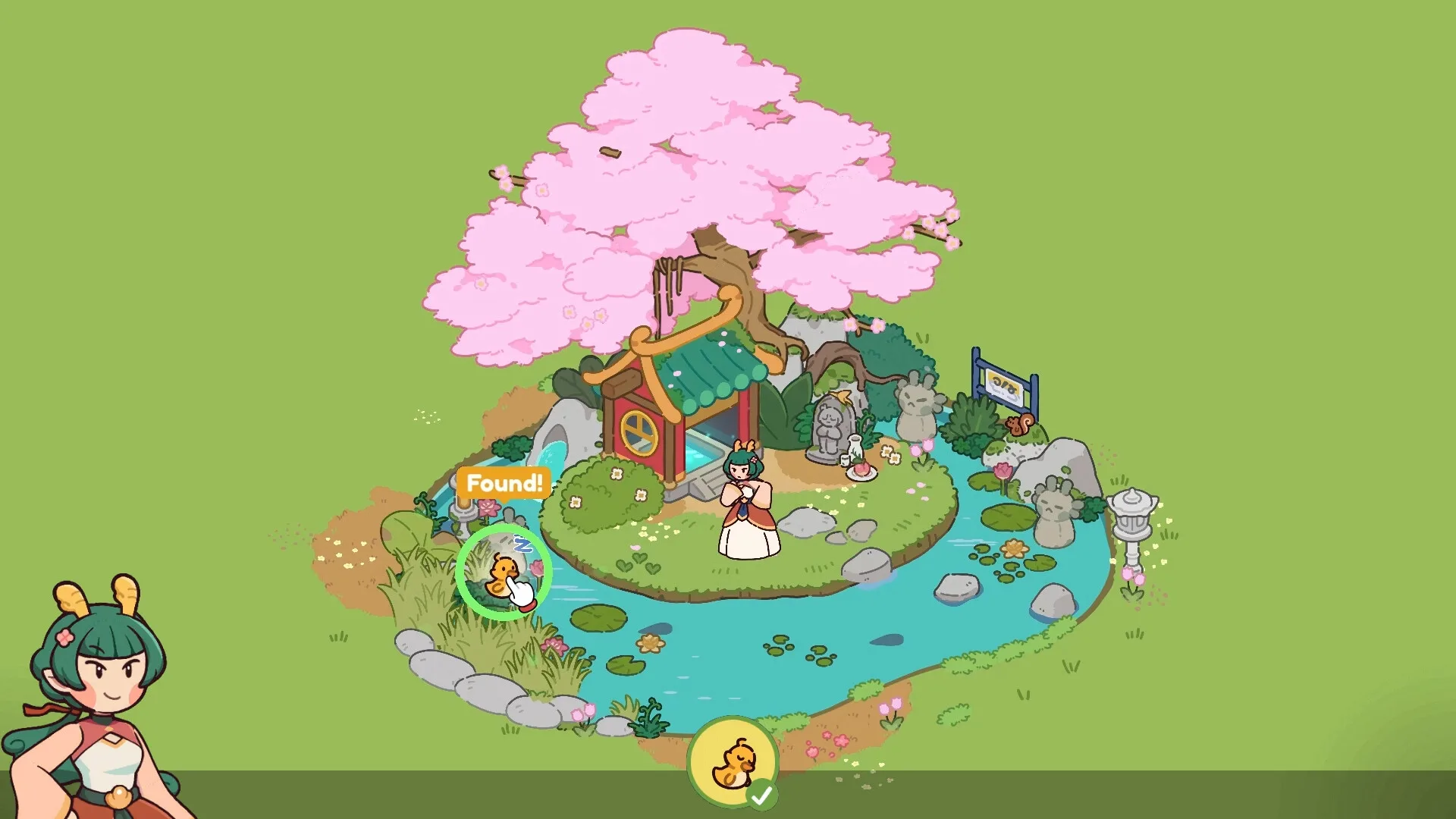
Goddess Mei gives assignments with minimal hand-holding. There is no quest marker hovering over every NPC, no giant exclamation points, no "speak to the merchant" pop-up. You get a description of the lost item, a description of its owner, and the general area of town where things tend to go missing. Finding the item requires actual engagement with the environment rather than UI navigation. This is the right call. The moment I started reading scene details closely rather than sweeping my cursor in search of highlighted areas, the game opened up considerably.
The puzzle variety across the game's eight chapters is strong. Object combination puzzles, pattern-recognition challenges, dialogue-tree mini-games, a delightful musical sequence in chapter five that I will not spoil. Bit Egg kept finding new ways to layer complexity onto the fundamental hidden object loop, and the pacing is confident — easier moments to breathe, harder moments to lean forward.
Graphics & Performance
The visuals are the reason Lost and Found Co. has a 10/10 in that category from me, and I do not give those out lightly. This is the best 2D animation I have seen in a game since Cuphead, full stop. Every scene is a diorama of activity. Background characters walk, converse, chase their children, tend their stalls, argue with each other, react to weather changes. A vendor fans herself in the afternoon heat. A child trips on a cobblestone and looks around to see if anyone noticed. An elderly man feeds birds who have strong opinions about the quality of the seed he is offering.
The character animation for Ducky and the main cast is equally exceptional. Ducky waddle-walks when happy, drags their feet when exhausted, stands very still when anxious (ducks do this; someone at Bit Egg clearly did research). Expressions are communicated through body language as much as facial animation, which is a genuine achievement for 2D work. Goddess Mei's hair moves with a physics-simulation elegance that I kept noticing and appreciating across every scene she appeared in.
The art direction commits to a specific aesthetic — soft watercolor backgrounds behind precisely detailed foreground elements — and maintains it without compromise across every environment. Town square, underwater grotto, cloud market, night festival: each location has a distinct visual identity that never breaks the internal logic of the world's style.
Performance matches the visual ambition. The game runs at locked framerates on modest hardware, load times are nearly nonexistent, and I encountered zero crashes across my full playthrough. For a studio of this size to ship this cleanly is an achievement worth noting.
Story & Narrative
Ducky's arc — coming to terms with sudden humanhood, finding purpose in connecting people with things they have lost, gradually uncovering why Goddess Mei's company exists at all — is genuinely moving by the end. Not in a melodramatic way. In the quiet way of a story that knows its emotional register and stays in it.
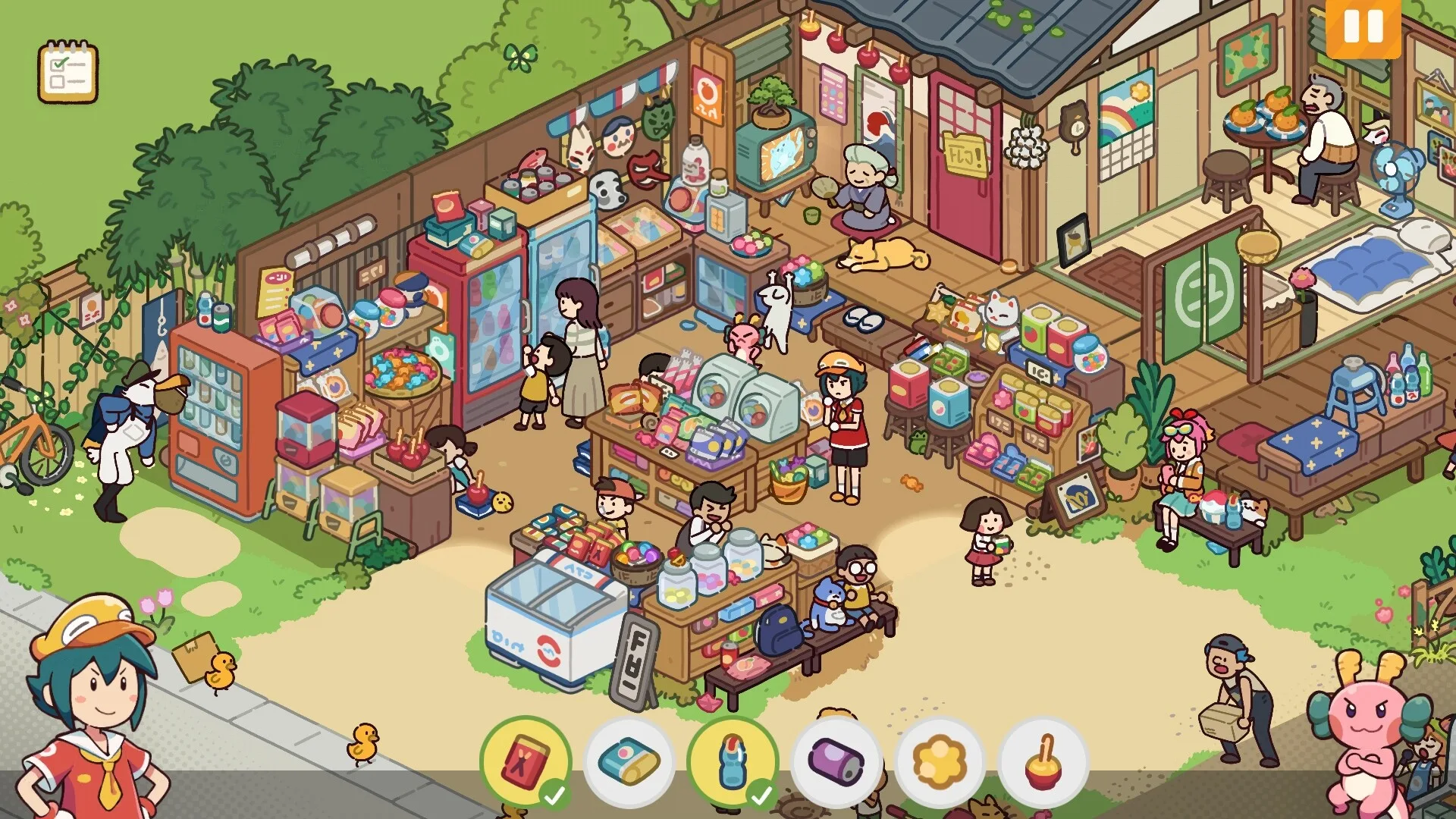
The townspeople are the highlight. Each client is a distinct, specific person: the baker who lost his grandmother's recipe card and will not explain why he left it outside; the young woman looking for a letter she wrote but never sent; the old cartographer who lost a map of a place that no longer exists. These are not video game NPCs delivering exposition. They are characters with histories, and the writing gives them enough specificity to feel real.
The story does not overstay its welcome — at around ten to twelve hours, it ends before it exhausts its premise. Some players will want more. I actually think the length is a virtue. It says what it needs to say and closes cleanly. The ending lands with genuine warmth.
My one complaint: the larger mythology around Goddess Mei and the nature of the magical startup is introduced with enough intrigue to make you want answers, and those answers are gestured at rather than fully delivered. It feels deliberately designed for a sequel. Whether that sequel arrives will determine whether this reads as restraint or unfulfilled promise.
Audio & Soundtrack
The score is the kind of game music that lives in your head uninvited for days after you stop playing. Main theme: a gentle, perpetually-in-motion piano piece with woodwind countermelodies that feels like early morning light coming through a window. Each chapter gets a distinct musical identity — the market theme is bustling and percussive, the night festival sequence has something almost gamelan-influenced, the underwater grotto uses bowed string harmonics that made me slow down just to listen.
Ambient sound design deserves equal credit. Environments are layered with location-appropriate audio: market chatter at a distance, birdsong that shifts species as you move through the park section, rain on different surfaces. The sound team clearly walked through each scene and asked "what would I actually hear here?" then recorded it. The result is an aural environment that reinforces the visual density rather than fighting it.
Voice acting is selective but strong. Ducky's internal monologue is delivered with a perfect mix of uncertainty and enthusiasm. Goddess Mei has the confident cadence of someone who has been answering questions since before your civilization existed. Supporting cast varies — a few townspeople performances are slightly flat — but the principals carry the emotional weight of the story with genuine craft.
Value & Replayability
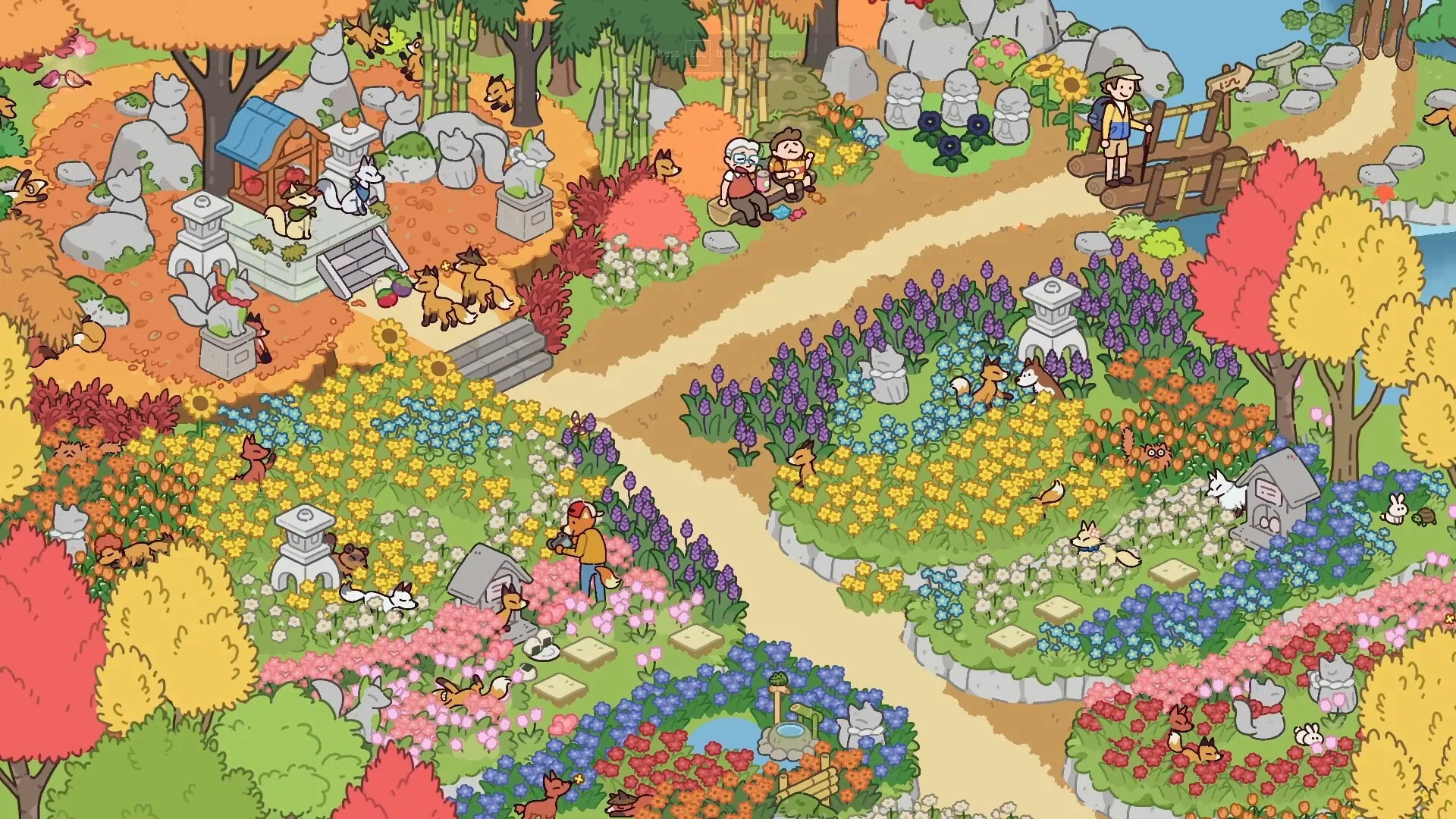
Ten to twelve hours for the main story, with collectible items and hidden secrets pushing completionists toward fifteen. The game does not have the mechanical replayability of something like Esoteric Ebb — there are no branching story paths, no opposing playstyle options. What it has is a world dense enough to reward a second pass specifically for the ambient details you missed the first time.
At its launch price, Lost and Found Co. is priced appropriately for its length. It is a shorter experience than many players expect from a $20 game, and that is worth acknowledging honestly. The quality justifies the price point, but players expecting 40-hour epics should calibrate accordingly.
That said: the ten hours I spent with Lost and Found Co. were among my most sustained in recent memory. It held my attention completely from start to finish, which is harder to achieve than most game length discussions acknowledge. A short game that never loses you is worth more than a long game that loses you twice.
Final Verdict
Lost and Found Co. is a masterpiece of craft. The animation alone earns it a place in gaming's visual canon. The writing is warm, specific, and funny without condescension. Ducky is the kind of protagonist who makes you want the sequel to exist so you can spend more time with them. Goddess Mei is already iconic.
The limitations are real: the story ends a beat before you want it to, the puzzle difficulty eases off when it should press harder, and replayability beyond a second pass is minimal. These are honest criticisms of an otherwise exceptional game.
Bit Egg Inc. is Thailand's largest indie studio, and Lost and Found Co. is the kind of release that announces a studio to the world. Pay attention to what they do next.
Buy if:You value craft, warmth, and visual artistry in games. This is the most purely delightful release of 2026 and earns its 90 Metacritic without argument.
Skip if:You need long-form content or robust replayability to justify a purchase. Wait for a sale if ten hours feels short for your threshold — but do not skip it entirely.
Pros
- Animations are in a class of their own — every environment breathes, moves, and reacts
- Ducky is an immediately lovable protagonist with a distinct voice and personality
- Hidden object scenes reward patience and observation without resorting to pixel hunting
- Townspeople are memorably weird and written with genuine affection
- Audio design is exceptional — ambient sound layers and musical motifs that shift per scene
- Rock-solid technical performance with near-zero load times
Cons
- Story wraps up somewhat quickly and leaves room for a sequel that has not yet been announced
- Puzzle difficulty is front-loaded — later chapters ease off in ways that slightly undercut the satisfaction
- Replayability is limited once the secrets are found, making it a single-sitting experience for most
Frequently Asked Questions
- Is Lost and Found Co. worth it?
- Yes, without reservation. Lost and Found Co. holds a 90 Metacritic and 90 OpenCritic score, making it the highest-rated game of 2026 so far. The animation quality, writing, and puzzle design are exceptional. The main story runs 10-12 hours, which is shorter than some players expect, but the quality of every hour justifies the price.
- How long is Lost and Found Co.?
- The main story takes approximately 10-12 hours to complete. Players seeking full completion — all collectibles, hidden secrets, and optional discoveries — can extend that to around 14-15 hours. It is a shorter experience than open-world games but paced tightly with no filler.
- What kind of game is Lost and Found Co.?
- Lost and Found Co. is a hidden object puzzle adventure game with strong narrative elements. You play as Ducky, a duck transformed into a human intern, helping clients find lost items at Goddess Mei's magical startup. Expect richly detailed scenes, inventory-style puzzle-solving, character interactions, and a warm fantasy story.
- Is Lost and Found Co. suitable for kids?
- Yes. Lost and Found Co. has a charming, family-friendly tone with no violence, mature content, or disturbing themes. The puzzle complexity is accessible to older children, and the visual style and humor will appeal to both kids and adults. The story deals with themes of belonging and purpose in age-appropriate ways.
- Who made Lost and Found Co.?
- Lost and Found Co. was developed and published by Bit Egg Inc., Thailand's largest indie game studio. The game released on March 5, 2026 for PC via Steam. It represents Bit Egg's most ambitious release to date and has drawn international critical attention for its exceptional animation quality and game design.
Game Info
- Developer
- Bit Egg Inc.
- Publisher
- Bit Egg Inc.
- Release Date
- 2026-03-05
- Platforms
- PC
- Genres
- Adventure, Indie